
Nuncio: Pope Leo ‘Will Speak to the World’ in Africa
INTERVIEW: Archbishop José Avelino Bettencourt, the apostolic nuncio to Cameroon and Equatorial Guinea, discusses the significance of Pope Leo XIV’s upcoming visit to the two African nations.
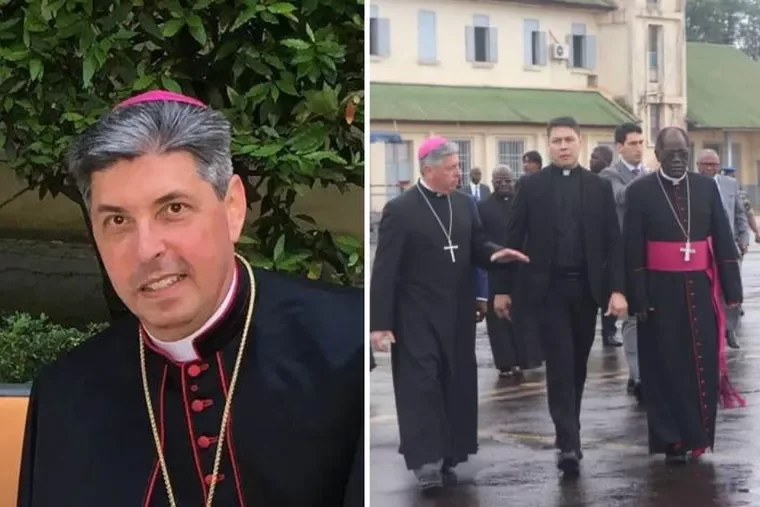
Archbishop José Avelino Bettencourt, the apostolic nuncio to Cameroon and Equatorial Guinea, is shown in Cuidad de la Paz, the capital of Equatorial Guinea, in February 2026 with a delegation preparing for the visit of Pope Leo XIV to the African nation in April 2026. (photo: Nunciature to Yaoundé/CC BY-SA 4.0)
Pope Leo XIV is ready to engage in a 10-day trip to Africa, to visit Algeria, Angola, Cameroon, and Equatorial Guinea. The nuncio for the latter two countries is Archbishop José Avelino Bettencourt, who arrived in 2023 after serving as the Pope’s ambassador to Armenia and Georgia.
In this interview conducted via email, the nuncio, 63, who participated in the preparatory meetings for the trip, explains the significance of the Pope’s visit. The interview has been edited for length and clarity.
Why is Pope Leo’s visit to Cameroon and Equatorial Guinea meaningful?
It is very significant on various levels. First, on a spiritual level, we know that His Holiness is a religious and a member of the Augustinian Order. St. Augustine is one of the greatest saints in the Church, a Church Father and one of 39 Doctors of the Church. St. Augustine was born in Africa. Pope Leo XIV sees himself very much as a spiritual son of St. Augustine and therefore a “son of Africa,” a continent where the faith is absolutely exuberant today.
On an ecclesiastic level, Africa, and more specifically Cameroon and Equatorial Guinea, where I am apostolic nuncio, are churches where there has been a multiplication of dioceses, almost every religious order is present, there is a Catholic university, the Church has stepped up to meet the challenges in very creative and proactive ways.
On the level of witnessing to Christ, the Church is present in the most far reaching and peripheral regions with their schools, hospitals, social centers, and it is close to the population. …
This year, 2026, we celebrate the 60th anniversary of official diplomatic relations between the Holy See and Cameroon. Hence, from across the continent of Africa, there are multiple reasons on multiple levels to understand the importance of this apostolic journey.
What are the main topics the Pope could develop during his visit?
Africa is a continent with many beautiful things and [has] its challenges, just like every other continent in the world. Just like in Europe, the question of peace is central. Just like in the Americas, the question of social justice is central. Just like in Asia, the question of human dignity is central.
Hence, in Africa, the Holy Father will speak to the world. In Cameroon, the Holy Father will speak in English and French, in Equatorial Guinea, he will speak in Spanish, just as in Angola he will speak in Portuguese. Above all, he will speak the language of the Gospel to the faithful of the Catholic Church. It will be a celebration of the Good News of Jesus Christ, who can change minds and hearts and bring light and hope to our common future.
Who are the characters of the local Churches of Equatorial Guinea and Cameroon?
I am particularly impressed with the participation of the faithful in the African Church, particularly in Cameroon and in Equatorial Guinea, where I have the honor to serve as apostolic nuncio. Last year, we celebrated the 75th anniversary of the oldest diocese in Cameroon, the Diocese of Buéa.
It has its own particular history, given the initial German presence, then English and French. Between the transition from the German presence to the English presence, there was a long hiatus of a number of years when priests were prohibited from going to the region. The Church continued thanks to the activity of catechists who kept and animated the churches, who kept the registers, who taught the Word of Christ and who prepared the faithful for the sacraments.
In Equatorial Guinea, the Gospel was brought to the far reaches of the interior of the rainforests of the country by a layman. He learned about the prayer and meditation of the Holy Rosary from a missionary priest he met in the coastal region where he traveled to trade with foreign traders. He began praying the Rosary and brought it with him to his village. The prayer soon spread, and they came to know about Jesus Christ through the meditations. This was followed by missionaries who established missions with schools and hospitals, and the Gospel began to be read. Today, the second- largest church in Africa, the Basilica of Our Lady of the Immaculate Conception [in Mongomo], stands among the interior rainforests as a testament to faith. It is an absolutely extraordinary history.
The Church in Buéa, in Cameroon, the Church throughout Equatorial Guinea and the Church throughout the African continent is animated thanks to so many faithful who are committed and engaged in the evangelical mission of the Church.
Thirty years ago, John Paul II signed in Yaoundé, Cameroon, the post-synodal apostolic exhortation Ecclesia in Africa. Is that document still valid?
Ecclesia in Africa remains a timeless document. After St. John Paul II’s signing of the document in Yaoundé in 1995, it was followed by Pope Benedict XVI’s 2009 visit in the context of the second Synod of Africa. Every generation is called to examine and meet the questions of their times. This was true in 1995 and 2009, and the Synods on Africa have given the Church in Africa a far-sighted view of their apostolate.
I would like to recall the immense importance of catechists in Africa. Everywhere I visit, I find myself praying before the tomb of extraordinary catechists who gave their lives so generously for the cause of the faith. I believe that one day many of these catechists will be recognized as “martyrs” of the faith. There is a deep sense of family and faith. The African Church has brought this gift, and many other gifts, to the fore of the universal Church. Ecclesia in Africa, which in 2025 celebrated the 30th anniversary of its promulgation, remains a document of reference to be further studied and further put into practice.
Pope Leo will also visit Angola and Algeria during his trip. How are all these African countries connected?
There is a long and broad meaning to this very important visit. Pope Leo XIV’s apostolic journey to Africa also brings to mind that the Christ Child himself fled to Egypt, Africa, under a particular context. Africa has always played an essential role in the Christian faith with its very own historical presence.
As the Christian faith spread throughout the continent and the sacraments were celebrated, we saw very special individuals rise to the service of the Gospel. Besides the known saints and martyrs of this continent, there are figures like the son of the King Afonse [Afonso I]of Congo, who became the first sub-Saharan bishop to be consecrated in the early 15th century. He was auxiliary to the Archdiocese of Funchal that extended to Japan, and he exercised his ministry for some 10 years. At the same time, another son of King Afonse of Congo was made the first sub–Saharan African ambassador to reach Rome. His remains are found at Santa Maria Maggiore Basilica in Rome. Christianity encompassed the whole continent right to the southern points where Catholic life is alive today.
Many more examples can be given, yet in these couple of examples we can understand that Africa is a continent of a wealth of culture, traditions, of human resources, and above all of faith.
The apostolic mission of the Church in Africa was and continues to be truly an epic history. The Holy Father ’s Apostolic Journey to Africa is filled with meaning.
How are the faithful preparing for the papal visit? And what will be next?
The announcement of the apostolic journey of Pope Leo XIV to Africa was met with the greatest of joy, gratitude and a profound sense that this is the source of a special blessing. The Church is celebrating the liturgical Lenten season and this moment is particularly propitious for a spiritual preparation for the visit. The Episcopal Conference of Equatorial Guinea has prepared a pastoral letter that contextualizes the visit and proposes a spiritual itinerary, including a prayer for the Holy Father and his visit to Equatorial Guinea. The Episcopal Conference of Cameroon has begun preparing the faithful on the parish and diocesan levels to follow the liturgical season’s itinerary and contextualize the Apostolic Journey in that liturgical and spiritual itinerary.
The fervor of the faithful is palpable. The preparations are in the process of completion and all will be on the streets, roads and byways to welcome the Holy Father to Africa.
Interview by Andrea Gagliarducci
March 18, 2026