
Pope Leo XIV in Africa: The Catholic Church in Cameroon
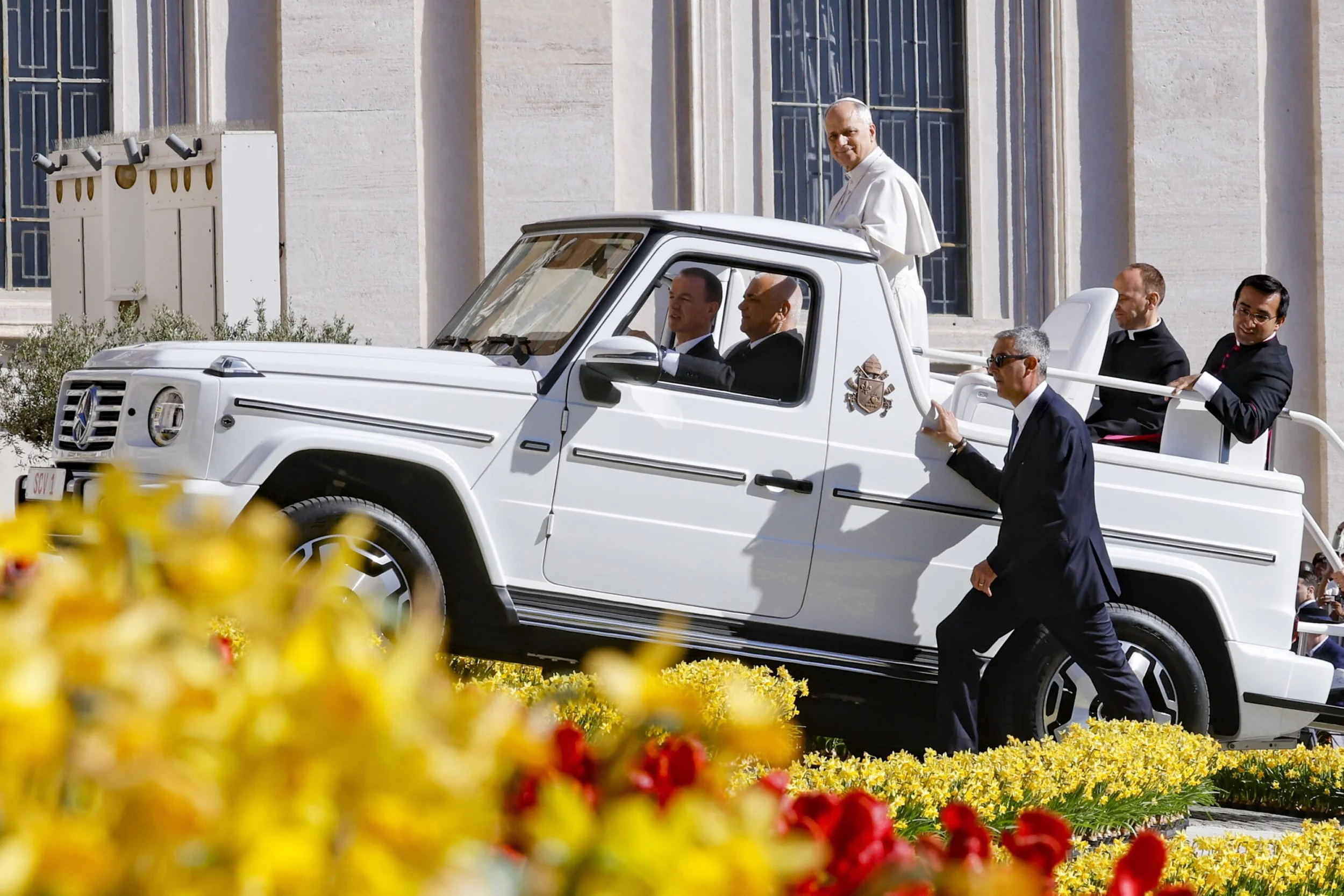
Pope Leo XIV during the weekly general audience in St. Peter’s Square, Vatican City, on April 8, 2026. ANSA/FABIOFRUSTACI
The Republic of Cameroon, with a population of 33 million and over 250 ethnic groups, is the only officially bilingual African country, with English and French as its official languages. It stretches from the Atlantic Ocean to the Sahara, but faces significant challenges such as a separatist movement in the Anglophone regions and the threat of Boko Haram in the north, which has caused the displacement of entire populations.
The two main religions are Christianity and Islam: approximately 70% of the total population is Christian, while 20% is Muslim, the vast majority of whom are Sunni. Among Christians, there are Catholics (35–36%) and Protestants (25–26%), as well as members of other Christian denominations.
The Catholic Church in Cameroon: The Missionary Seed
Pope Leo XIV’s visit to Cameroon is the fourth apostolic visit by a pontiff, following those of John Paul II in 1985 and 1995, and of Pope Benedict XVI in 2009. The last two papal visits were closely linked to the Synods on Africa, and the pontiffs were welcomed in the capital, Yaoundé, by a large gathering of African bishops.
On November 23, 2025, Pope Leo XIV issued a heartfelt appeal for peace and the release of hostages in Cameroon and Nigeria, expressing deep sorrow over the kidnapping of six priests and a Baptist pastor in Cameroon.
The upcoming apostolic visit will undoubtedly represent a powerful moment of hope for reconciliation and peace.
The Catholic Church in Cameroon was officially founded in Marienberg on December 8, 1890, by German Pallottine missionaries led by Henri Vieter, with the consecration of the country to Mary, Queen of the Apostles, on that day. Andréas Kwa Mbangue, the first Cameroonian baptized in 1889, left his job as a baker to devote himself to evangelization alongside the missionaries. His life was marked by a strong apostolic commitment until his death in 1932. The mission’s initial results were remarkable, with nearly 16,000 baptisms and a growing network of missionary schools.
Marienberg, located near Edéa in the Littoral region, quickly became a significant center of evangelization, serving as a spiritual cradle and a symbol of resilience. The missionaries faced tropical diseases, hostility, and extremely difficult living conditions. Many missionaries lost their lives, some even at sea during the journey. Despite these losses, the mission continued to expand with the gradual establishment of new mission stations in Edéa and Kribi (1891), Bonjongo (1894), Douala (1898), Grand Batanga (1900), Yaoundé (1901), Ikassa (1906), Ngovayang (1909), Sassè (1907), Limbé (1908), Dschang (1910), Minlaba in Puma (1912), and Déido (1913). The missionaries learned the local languages, valued the cultures, and built schools, health centers, boarding schools, and technical workshops, gradually winning the trust of the local populations.
Wars, destruction, transitions, and a new wave of missionary expansion
Germany’s defeat in World War I led to the forced departure of the German Pallottine missionaries. The church at Marienberg was destroyed by Franco-British forces. However, evangelization did not come to a halt: the Spiritans, the Mill Hill Missionaries, the Oblates of Mary Immaculate, and other congregations took over the missions established by the Pallottines. Northern Cameroon was marked by the evangelizing work of the Oblates of Mary Immaculate, particularly that of the missionary and archbishop, Msgr. Yves Plumey (1913–1991). They received support from local catechists, courageous witnesses known throughout the country, such as Nestor Happie in Nkongsamba. There was a significant increase in the number of the faithful: over 67,000 people were baptized in 1931, followed by an explosion of conversions in the years following 1945. It was a veritable “Pentecostal outpouring.”
With 26 dioceses and the presence of over 300 religious congregations, Cameroon offers a wide range of religious charisms, ranging from Trappist, Poor Clare, and Carmelite traditions to the most modern expressions of the apostolate.
Between 1890 and 1970, evangelization relied primarily on European missionaries. Social and educational infrastructure was heavily influenced by resources from Europe. A significant turning point occurred in 1969 when Pope Paul VI, during his speech on the occasion of his apostolic visit to Uganda, issued a historic appeal: “Africans must take responsibility for their own Churches.”
With the independence of the Republic of Cameroon in 1960–61, the Holy See established diplomatic relations as early as 1966. To date, there have been 12 successive apostolic nuncios. “In 2015, the Holy See and the Republic of Cameroon signed a Framework Agreement defining the legal framework for cooperation in the fields of education and health,” states the current apostolic nuncio, H.E. Msgr. José Avelino Bettencourt.
A Church Rooted in Sacrifice and Centered on Hope
History teaches us that the Church in Cameroon was built on faith and sacrifice. Local figures of holiness and Christian commitment, alongside the first missionaries and Andréas Kwa Mbangue (the first person baptized in Cameroon), emerged as sources of inspiration: the missionary Baba Simon, considered the father of the Kirdis in the far north of Cameroon, known for his strong sense of Christian brotherhood, interreligious dialogue with the Muslim population, and his commitment to education and social development.
Other notable Cameroonian Catholic figures include the young Robert Naoussi (1947–1970), whose faith—demonstrated through his service to the lepers of Douala—had a profound impact on Christian communities. Also, the young friar Jean Thierry Ebogo, a Discalced Carmelite (1982–2006), who died in Italy after a long illness, leaving behind a “fragrance of holiness.”
Today, the Catholic Church in Cameroon is the fruit of the great fidelity of the first pioneering missionaries, the many local catechists, and the Christians who have continued the work of evangelization.