
Cameroon: First Exhibition in Africa Featuring the Pontifical Swiss Guard
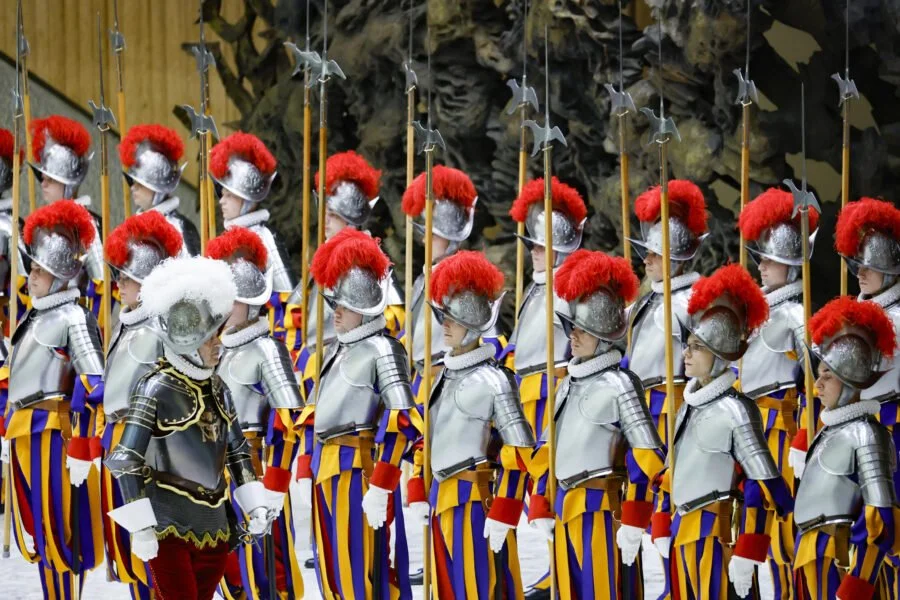
A moment from the swearing-in ceremony of the Swiss Guards on May 6, 2026, in the Paul VI Hall. Photo: ANSA/FABIO FRUSTACI
The Apostolic Nunciature in Cameroon opens its doors for a six-month exhibition of the Pontifical Swiss Guard on Friday, June 5, 2026, the first of its kind on the African continent.
Why in Cameroon?
To honour anniversaries or cultural milestones, exhibitions showcasing the history, uniforms, core values, and daily activities of the Pontifical Swiss Guard have been organized globally. These exhibitions often travel from the Vatican to different countries. While European nations and the USA have hosted similar events, this will be the first exhibition of its kind on African soil.
Archbishop José Avelino Bettencourt, the Apostolic Nuncio to Cameroon and Equatorial Guinea, remarked that "the rationale is twofold: firstly, to celebrate the 60th anniversary of diplomatic relations between the Holy See and Cameroon, and secondly, to 'prolong' the celebratory spirit felt during Pope Leo's Apostolic Visit to the nation, in a prayerful and contemplative setting that ultimately encourages all of us to ponder the Holy Father’s message conveyed through his words, gestures, and signs during his Apostolic Visit."
The Apostolic Nuncio affirmed that the visitors will also explore the Pope’s home in Yaoundé which represents the diplomatic mission of the Holy See. “It is an embassy and official residence and operational headquarters for the Papal Nuncio, serving exclusively as the Pope's residence during his Apostolic Visits, where the Holy Father spent 3 full days and 3 nights 50 days ago. Visitors will be able to recollect themselves in the Chapel where the Holy Father prayed. This could be an occasion to pray with him for world peace, to pray for him with the universal church”.
What is the exhibition about?
Established in 1506 under Pope Julius II, the Pontifical Swiss Guard also known as the Papal Swiss Guard or simply Swiss Guard is an armed force, guard of honour, and protective security unit, maintained by the Holy See to protect the Pope and the Apostolic Palace within the territory of the Vatican City State. It is the oldest military units in continuous operation and is sometimes called "the world's smallest army".
The Swiss Guard's security mission extends to the Pope's apostolic travels, the pontifical Residence of Castel Gandolfo, and the College of Cardinals when the papal throne is vacant.
The main objective of this exhibition, as stated by the Nuncio, is to engage with the general public in Cameroon regarding the values that inspire the Swiss Guards through a carefully curated visual presentation of displays and information.
Additionally, the exhibition will function for educational and knowledge-sharing purposes: it aims to inform the public about the specific values of the Swiss Guards, their historical significance within the extensive and rich history of the Church, and the cultural heritage of the Church. Furthermore, it will provide an opportunity for communication and cultural exchange: by serving as a platform to discuss Vatican City, the exhibition seeks to promote dialogue in a celebratory atmosphere between Cameroon and the Holy See.
Who is the target audience for the exhibition?
The exhibition is open to everyone who wishes to visit it, Archbishop Bettencourt affirmed. In a special way he affirmed that he has at heart the youth population. “My wish is that the Exhibition will attract Catholic youth from parishes, schools and beyond. But also, young people from other traditions. Cameroon has an extremely young population. As of early 2026, the average age is approximately 18.2 years, with over 40% of the population under 15 years old. Over 60% of the population are under 25, creating a large, youth-dominated demographic reality”.
The Nuncio believes “the Exhibition will have a special message to the young generations in particular because the Swiss Guard is considered World elite military unit, whose candidates must be unmarried Swiss Catholic males between 19 and 30 years of age. These are young men who serve with commitment to protect the Pope with their lives, based on faith, loyalty, and duty”. To a certain extent, the Apostolic Nuncio anticipate that the exhibition will serve as a platform for interaction with the Cameroonian youth.
Role models and examples form the essential foundation of youth development. They act as practical guides for behaviour, instructing young people on how to navigate social interactions, tackle challenges, and cultivate moral character. Through the observation of others, youth naturally learn to implement abstract values in their everyday lives.
“This exhibition provides young visitors with a chance to observe and engage with the life experiences of the Pontifical Swiss Guard. They will meet young men who embody values such as Unwavering Loyalty and Fidelity, Courage and Sacrifice, Deep Catholic Faith, Altruism, Discipline and Professionalism, as well as Commitment to Tradition. These guards uphold over 520 years of heritage, merging their 16th-century roots with contemporary security methods.
Additionally, the significance of honouring one’s word and solidifying it through promises is emphasized. The Oath: Every year on May 6th, new recruits take an oath to "...faithfully, loyally and honourably serve the Supreme Pontiff and his legitimate successors, dedicating myself to them with all my strength, even sacrificing my life if necessary to defend them."
The expected influence of exhibitions on young visitors.
Archbishop Bettencourt is confident that the exhibition will profoundly influence young attendees by eliciting reactions on multiple fronts: cognitive, emotional, educational, and behavioural. “Such an encounter can play a significant role in shaping their identity and values. It may also contribute to enhancing their self-esteem: when teenagers observe the success of others, it creates a form of "social proof" that they too can reach their own objectives. This cultivates a sense of belonging, boosts confidence, and motivates them to venture beyond their comfort zones”.
Another important aspect is the development of self-regulation, “role models are essential in teaching self-control and emotional management. Witnessing mentors handle challenges with resilience and patience enables young individuals to learn how to navigate their own emotions and behaviours”.
Additionally, guiding decision-making is crucial in the life of a young person, the Apostolic Nuncio, “adolescence is a period for exploring life’s purpose, career goals, and vocational paths. Having a visible role model assists youth in identifying concrete short-term and long-term objectives, offering them a clearer direction for their future”.
And finally, role model act as protective factors: “in challenging environments, the presence of strong, positive role models serves as a vital shield against high-risk behaviours, helping young people remain focused on constructive, future-oriented endeavours”.