
Pope Leo XIV in Equatorial Guinea: a country unlike any other in Africa
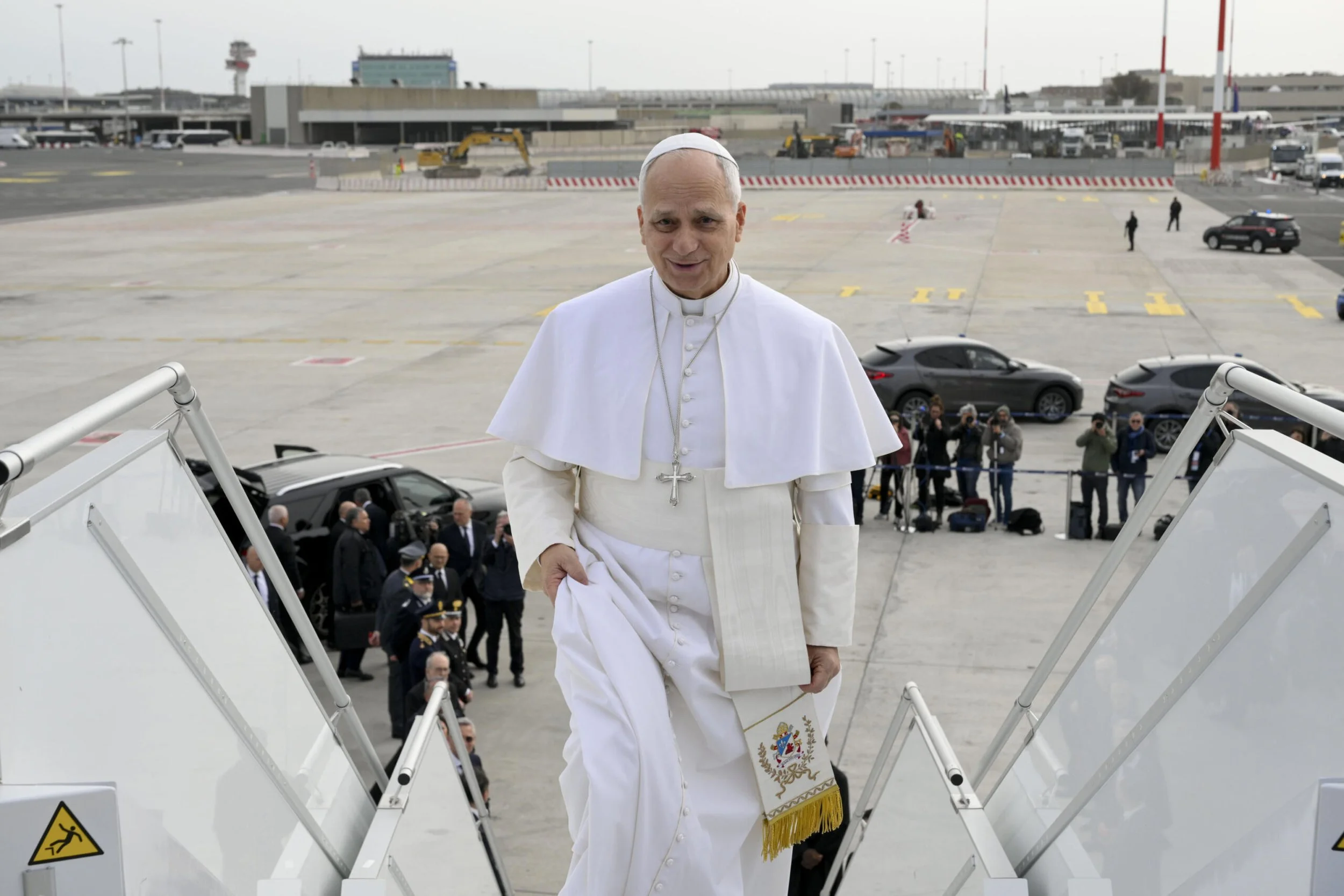
Pope Leo XIV at Fiumicino Airport, where he will board an ITA Airways Airbus A330neo bound for Algiers, the first stop on his Apostolic Journey to Africa, which will also take him to Cameroon, Angola, and Equatorial Guinea, April 13, 2026. Credit: ANSA/VATICAN MEDIA.
The Pope’s visit is scheduled for April 21–23. The country’s Catholic Church is joyfully preparing for the meeting with the Pontiff
Pope Leo XIV’s visit will be only the second papal visit in the country’s history: the first took place on February 18, 1982, when John Paul II visited Equatorial Guinea. During that visit, the Pope presided over a Mass in Bata and encouraged Catholics to live “in fidelity to Christ and the Church.” For many Equatorial Guineans, particularly those born after 1982, the upcoming papal visit will mark their first encounter with a living pope.
As preparations have begun for the arrival of Pope Leo XIV in the small Central African nation—which comprises the mainland of Rio Muni and five small volcanic islands offshore—the visit should be seen both as a moment of spiritual renewal and as an affirmation of the growing maturity of the local Church. Here are some key aspects of the Catholic Church in Equatorial Guinea.
With a distinct Catholic identity, Equatorial Guinea occupies a unique place on the continent—from a linguistic, historical, and ecclesial perspective. It is the only country on the continent where Spanish is the primary official language, a legacy of nearly two centuries of Spanish colonial rule that ended in 1968.
This history has significantly shaped the local Catholic Church. Evangelization was largely carried out by Spanish missionaries—particularly members of the Congregation of the Missionary Sons of the Immaculate Heart of Mary (Claretians)—whose pastoral methods, Marian devotion, and catechetical structures continue to influence parish life. Spanish remains the dominant language in the Catholic liturgy, ecclesiastical administration, and theological formation. At the same time, Equatorial Guinea is officially multilingual.
This fusion of Hispanic Catholic heritage and African cultural expression makes this Central African nation unique in the sub-Saharan region. Equatorial Guinea is one of the most Catholic countries in sub-Saharan Africa, not only in terms of cultural identity but also in terms of actual ecclesial reality. According to Vatican statistics, approximately 74.8% of Equatorial Guinea’s population is baptized in the Catholic rite.
Although this figure refers specifically to baptized Catholics—a standard metric used by the Vatican’s Central Statistical Office—it underscores the depth of the Catholic presence in a country with a population of just over 1.6 million. In practical terms, this translates into a Church that permeates national life, with parishes serving not only as places of worship but also as centers for education, healthcare, and social organization. Although Catholicism has deep historical roots in Equatorial Guinea, the local ecclesiastical hierarchy is relatively young and continues to evolve.
Members of Institutes of Consecrated Life and Societies of Apostolic Life continue to play a decisive role in the Catholic life of Equatorial Guinea. Reflecting on this history, the president of the Episcopal Conference, Bishop Juan Domingo-Beka Esono Ayang, observed that the Church has now entered “a period of new dynamics,” following the challenges of the past. This enduring missionary presence has helped to support vocations, catechesis, and social engagement, as well as education and healthcare, especially in the rural and island communities of this Central African nation.
The country currently has only one metropolitan see, the Archdiocese of Malabo, with four suffragan dioceses: Bata, Ebebiyin, Mongomo, and Evinayong. The latter two were established in April 2017. The leadership is now largely indigenous, marking a transition from missionary administration to local ecclesial responsibility. “This maturation provides a fundamental backdrop for Pope Leo XIV’s visit, which can be interpreted as recognition of a Church that has reached maturity.”
Relations between Equatorial Guinea and the Holy See have always been cordial. President Teodoro Obiang Nguema Mbasogo has met with several popes and has repeatedly expressed the government’s desire to host a papal visit. At the same time, the Church in Equatorial Guinea operates in a social context characterized by long-standing political stability, a certain degree of wealth derived from oil, and persistent social inequalities—realities that influence local expectations regarding the Pope’s message during his visit to the country.